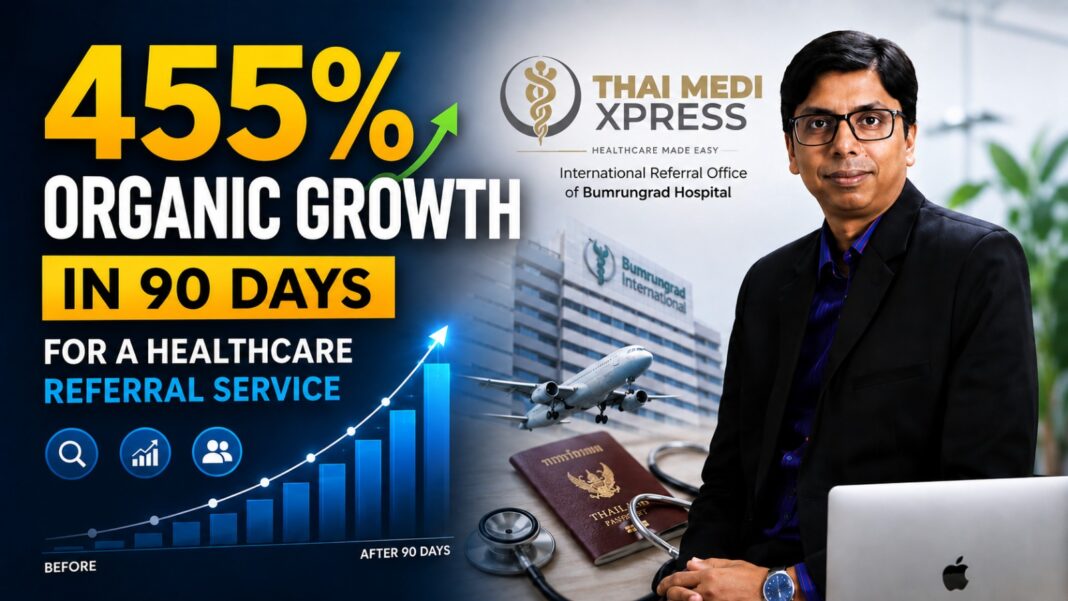
Thai Medi Xpress is the official referral office for Bumrungrad International Hospital in Bangladesh, helping patients in Dhaka and Chattogram book appointments, process visas, and arrange air ambulance transport to Bangkok. Healthcare is one of the least forgiving niches in SEO. Google holds Your Money or Your Life content to a stricter standard than almost any other category, and a referral service in this space cannot win rankings on volume or tricks. It has to earn trust the same way a hospital does, one verified detail at a time.
Between March 2026 and June 2026, three months of consistent on-page work, technical SEO, and dual-location Google Business Profile management moved organic traffic from 288 monthly visitors to 1,600, a 455% increase. Just as important for a YMYL brand, the site went from zero visibility on AI platforms to being cited on 47 pages across ChatGPT, Google AI Overviews, AI Mode, and Gemini. Here is the full breakdown, with no rounding up and no numbers left out.
Who Is Thai Medi Xpress?
Thai Medi Xpress operates as the official representative of Bumrungrad International Hospital in Bangladesh, with offices in Dhaka and Chattogram. The team coordinates doctor appointments, treatment cost estimates, second opinions, Thailand medical visa support, and emergency air ambulance service for Bangladeshi patients traveling to Bangkok for treatment. It is a sister concern of Surecell Medical BD Ltd.
This is a facilitation and referral business, not a hospital, and the SEO work reflects that distinction. The goal was never to make medical claims or promise treatment outcomes. It was to make sure that when someone in Bangladesh searches for how to reach Bumrungrad Hospital, get a medical visa to Thailand, or book an emergency air ambulance, Thai Medi Xpress shows up as a clear, credible, verifiable option.
Why This Niche Demands a Different Standard
Medical and health-adjacent websites fall under Google’s YMYL classification, which means E-E-A-T signals carry more weight than they do for most other industries. A vague claim or an unverifiable statistic does more damage here than it would on a typical local business site.
That shaped every part of the work:
- No content was written to imply medical outcomes or guarantees
- Every service page stayed factual about what Thai Medi Xpress actually does: coordination, logistics, and access, not treatment
- Trust signals like the JCI accreditation of Bumrungrad Hospital, the physical Dhaka and Chattogram office addresses, and direct phone numbers were reinforced across pages instead of buried
- Local business signals (Google Business Profile, NAP consistency, address verification) were prioritized because a patient or family member searching in an emergency needs to confirm a real, contactable office exists
What We Did
Dual-location Google Business Profile management. Thai Medi Xpress operates from two cities, Dhaka and Chattogram, and each office has its own Google Business Profile. Both were optimized and are managed on an ongoing basis, since a patient searching from Chattogram needs to find the Chattogram office, not a Dhaka listing with the wrong address and phone number attached.
On-page SEO. Service pages covering doctor specialties, air ambulance service, visa processing, and each city office were structured around the specific terms patients and families in Bangladesh actually search, rather than generic medical tourism keywords with no local intent behind them.
Technical SEO. Site health issues that block indexing or slow down page speed were identified and fixed. For a YMYL site, technical reliability is also a trust signal. A broken or slow site raises doubt in a category where doubt is expensive.
Quality link building. Off-page work focused on relevant, credible sources rather than volume, which matters more in healthcare than in almost any other niche, where a single low-quality or spammy backlink can do more harm than ten good ones can offset.
The Results: March 2026 vs. June 2026
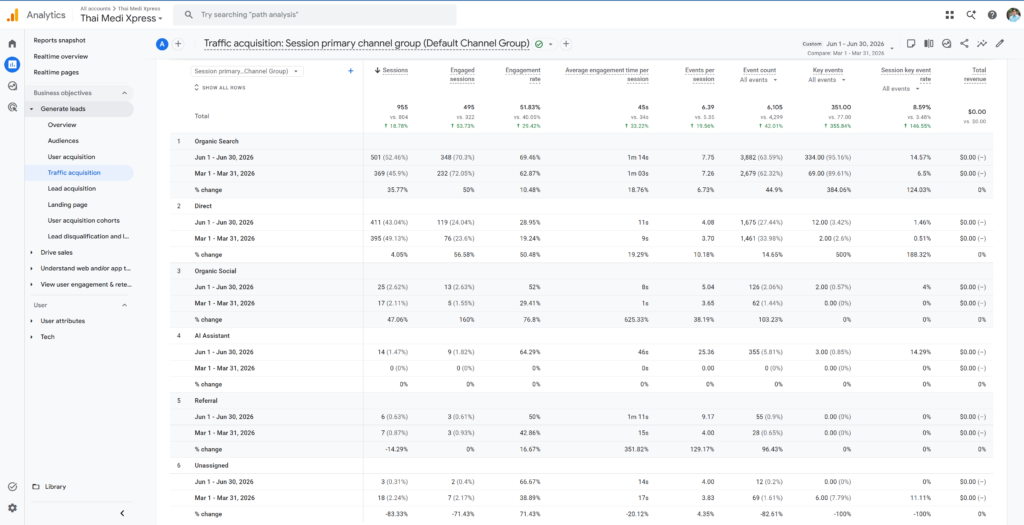
All figures below come directly from the client’s GA4 property and Semrush domain overview, comparing the March 2026 baseline to the June 2026 snapshot after three months of work.
Website Traffic and Engagement (GA4)
| Metric | March 2026 | June 2026 | Change |
|---|---|---|---|
| Total sessions | 804 | 955 | +18.78% |
| Engaged sessions | 322 | 495 | +53.73% |
| Engagement rate | 40.05% | 51.83% | +29.42% |
| Avg. engagement time per session | 34s | 45s | +33.22% |
| Key events (site-wide) | 77 | 351 | +355.84% |
| Session key event rate | 3.48% | 8.59% | +146.55% |
Organic Search Specifically
| Metric | March 2026 | June 2026 | Change |
|---|---|---|---|
| Organic search sessions | 369 | 501 | +35.77% |
| Engaged sessions | 232 | 348 | +50% |
| Engagement rate | 62.87% | 69.46% | +10.48% |
| Key events from organic search | 69 | 334 | +384.06% |
| Share of all site key events from organic search | 89.61% | 95.16% | — |
Organic search was already the strongest engagement channel in March, with a 62.87% engagement rate against 19.24% for direct traffic. By June, organic search was responsible for 95.16% of every meaningful action taken on the site, appointment inquiries, WhatsApp clicks, and consultation form submissions included. This is not just a traffic story. It is organic search becoming the channel that actually connects patients to the office.
Domain Visibility (Semrush)
| Metric | March 2026 | June 2026 | Change |
|---|---|---|---|
| Organic traffic (Semrush estimate) | 288 | 1,600 | +455% |
| Organic keywords | 254 | 191 | -25% |
| Traffic share, Bangladesh | 43% | 74% | +31 points |
| Authority Score | 18 | 18 | No change |
| Referring domains | 397 | 397 | No change |
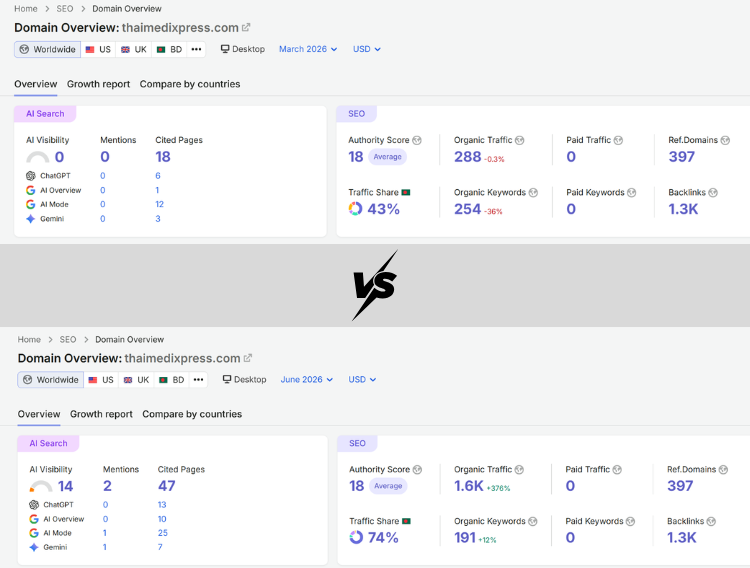
One number here needs an honest explanation rather than a celebration. Organic keywords dropped from 254 to 191 over the same period that organic traffic grew 455%. That is not a contradiction, and we are not going to hide it. A large keyword count with low rankings does not move a business forward. What happened here is consolidation: the site now ranks for fewer, more relevant terms, and it ranks for them in positions that actually get clicked, instead of sitting on page three for 254 keywords nobody found. Traffic share within Bangladesh growing from 43% to 74% backs this up. The site captures far more of its relevant Bangladesh search market with a tighter, stronger keyword footprint.
Referring domains and Authority Score held flat in this Semrush snapshot at 397 and 18. Off-page link building was part of the scope this quarter, and Semrush’s crawler typically lags real-world link acquisition by several weeks, so this number is worth revisiting in the next reporting cycle rather than treated as the full picture today.
AI Search Visibility: From Zero to Cited
This is the number we think matters most for where healthcare search is heading. In March 2026, Semrush recorded zero AI Visibility for thaimedixpress.com. Zero mentions across ChatGPT, Google AI Overview, AI Mode, and Gemini, and only 18 pages cited in total.
By June 2026, AI Visibility had moved to 14, with 2 direct mentions and 47 cited pages across those same four platforms. AI Mode alone went from 12 cited pages to 25.
This is not a number we are reporting from Semrush alone. GA4 backs it up with real user behavior. In March 2026, the “AI Assistant” channel in Thai Medi Xpress’s traffic acquisition report did not exist as a source, zero sessions across the board. In June 2026, that same channel brought 14 sessions and 3 key events, a 14.29% session key event rate, higher than every other channel on the site except organic search and direct.
For a YMYL healthcare brand, being cited by AI platforms when someone asks about Bumrungrad Hospital, medical visas to Thailand, or air ambulance services from Bangladesh is becoming as important as ranking on Google itself. Patients researching a health decision increasingly start that research in ChatGPT or an AI Overview before they open a search results page. Going from completely invisible to real, trackable AI referral traffic in one quarter is the kind of result that traditional keyword tracking alone would have missed entirely.
What This Means for Healthcare and Medical Referral Businesses in Bangladesh
If you run a hospital referral office, diagnostic center, medical tourism facilitator, or any YMYL business in Bangladesh, the lesson from Thai Medi Xpress is not “get more keywords.” It is the opposite. Fewer, stronger keyword rankings outperformed a broader, weaker footprint. Trust signals, verified local presence in every city you serve, and technical reliability did more work than aggressive content volume.
The AI visibility shift is the part every YMYL business should be paying attention to right now. If your site has never been cited by an AI platform, that is not a future problem. Based on this data, it is already showing up as real, measurable traffic today.
Services Provided to Thai Medi Xpress
- Google Business Profile management for both the Dhaka and Chattogram offices
- On-page SEO across doctor specialty, service, and location pages
- Technical SEO and site health monitoring
- Quality link building
- Monthly GA4 and Search Console performance tracking
Frequently Asked Questions
Why does SEO for a healthcare referral business need a different approach?
Google classifies medical and health-related sites as Your Money or Your Life content, which means accuracy, verifiable trust signals, and a real, contactable business presence matter more than they do for most other industries. Overstated claims or thin content carry a higher risk of hurting rankings in this niche than in almost any other.
Why did organic keywords go down while traffic went up?
A large number of low-ranking keywords does not generate traffic. What moved Thai Medi Xpress forward was ranking higher for a smaller, more relevant set of terms that patients in Bangladesh actually search, which is reflected in the traffic share growing from 43% to 74% within Bangladesh specifically.
Is AI search visibility something a real business should track?
Yes. Thai Medi Xpress had zero AI Visibility in March 2026 and moved to 14 by June, with a real, trackable “AI Assistant” traffic channel appearing in GA4 for the first time. As more people research medical decisions through AI platforms before searching Google directly, this is becoming a measurable channel, not a theoretical one.
Why manage two separate Google Business Profiles instead of one?
Thai Medi Xpress serves patients from both Dhaka and Chattogram, and each office has its own address, phone number, and local search audience. A single shared listing would confuse local intent and could send a patient in Chattogram to the wrong office. Each city needs its own accurately managed profile.
Can this same strategy apply to other YMYL businesses in Bangladesh?
Yes, with adjustments. The core discipline, verified local presence, technical reliability, and content that stays factual instead of promotional, applies to any hospital, clinic, diagnostic center, or medical referral business. The specific keyword and content plan will differ based on your services and the cities you serve.
Work With Md Faruk Khan
Thai Medi Xpress did not grow by chasing keyword volume. It grew by fixing what a YMYL healthcare brand actually needs: verified local presence in every city it serves, technical reliability, and content that earns trust instead of overselling it.
If you run a healthcare, medical referral, or other YMYL business in Bangladesh and want an SEO consultant who reports on real GA4 and Semrush numbers instead of vague promises, I take on a limited number of clients each quarter to keep every account properly managed.
For businesses managing more than one city location, our local SEO service page covers the same multi-location GBP process used here. You can also see how a similar local-first approach played out for Pet Zone BD, an e-commerce brand that grew from near-zero visibility.
Disclaimer: This case study is published with client consent. The SEO strategy, execution, and reporting for Thai Medi Xpress were led by Md Faruk Khan, CEO of Khan IT. Figures are sourced directly from Thai Medi Xpress’s Google Analytics 4 property and Semrush domain overview. This case study describes marketing and search visibility performance only and makes no claims about medical treatment, outcomes, or the practice of medicine. Individual results vary by business, competition, and market conditions, and past results do not guarantee future performance.