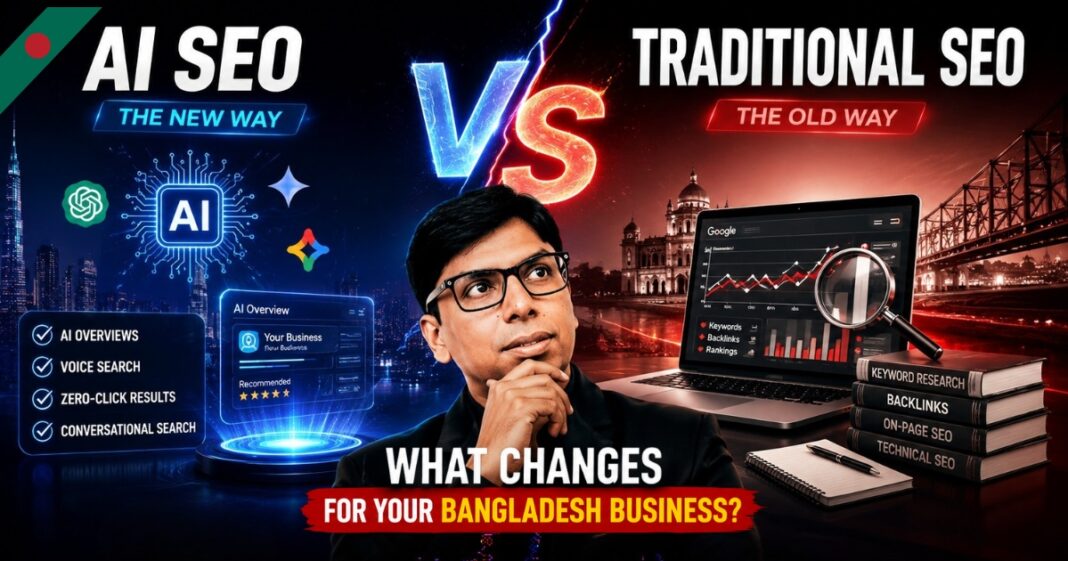
Your website can rank number one on Google and still lose the customer. That sentence would have sounded wrong five years ago. Today it is simply how search works, and the gap between AI SEO and traditional SEO is exactly why.
The Short Answer
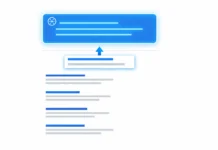
Traditional SEO gets your website onto the results page. AI SEO gets your business mentioned inside the answer, sometimes without the customer ever seeing a results page at all. Both matter. Neither replaces the other. But the tactics that win each one are not identical, and treating them as the same thing is where most Bangladeshi businesses are losing ground right now without realizing it.
Here is what actually changes, one piece at a time.
Change 1: From Keywords to Conversations
Traditional SEO trained everyone to think in short keyword phrases, such as “furniture shop Dhaka” or “best SMM panel.” That is still worth targeting. But when someone opens ChatGPT or Gemini, they rarely type like that. They ask full questions, the way they would ask a friend: “Which furniture shop in Dhaka has the best quality for the price?” or “I run a small SMM panel, who can actually fix my SEO?”
This changes how your content needs to be written. A page built only around a short keyword, repeated a few times, gives an AI system very little to actually quote. A page that answers the full, natural question in plain sentences gives the AI something it can lift directly into its response.
Change 2: From Backlinks Alone to Entity Trust
In traditional SEO, backlinks have long been one of the strongest ranking signals. That has not disappeared. But AI systems weigh something broader alongside it, often called entity trust: does the internet, as a whole, consistently agree on who you are, what you do, and whether you are reliable?
This means your business name, address, phone number, and description need to match exactly across your website, Google Business Profile, Facebook page, Clutch or Trustpilot profile, and any directories you appear in. A mismatch, even something small like an old phone number still listed somewhere, makes it harder for an AI system to confirm you are who you say you are, which lowers the chance it will mention you at all.
Change 3: From Clicks to Citations
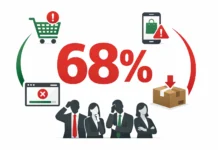
This is the change with the biggest financial impact, and the one fewest business owners have noticed yet. According to SparkToro’s analysis of Similarweb clickstream data, around 68 percent of US Google searches in early 2026 ended without a single click to any website (Search Engine Land, Google zero-click searches reach 68% in early 2026). Pew Research Center found that when a Google AI Overview appears, only 8 percent of users click through to a source, compared to 15 percent when no AI Overview is shown.
Read that again. Your page can be technically excellent and still receive almost no visits, simply because the answer was already given on the results page. In traditional SEO, a click was the goal. In AI SEO, the goal shifts one step earlier: getting named as the answer, whether or not a click ever happens. A brand named and recommended inside that answer still reaches the customer at the exact moment of decision, click or no click.
Change 4: From Ranking Position to Answer Extraction
Ranking first for a keyword used to be the whole game. It still matters, since AI systems tend to read from sources that already rank well. But ranking first no longer guarantees you get quoted. AI systems choose which parts of a page to pull into an answer based on how clearly the information is structured, not just how high the page ranks.
A page with a direct answer in the first two or three sentences, followed by clear subheadings and short paragraphs, is far easier for an AI system to extract from than a long, unstructured page that eventually answers the question somewhere in paragraph six.
What This Means for Local Businesses in Bangladesh
If you run a shop, clinic, agency, or service business that serves customers physically in Bangladesh, the local layer of this has not changed much, and that is good news. Your Google Business Profile, local reviews, and consistent local citations remain some of the strongest trust signals available, for both traditional local search and AI platforms. What has changed is the audience asking. More customers are now asking an AI assistant for a recommendation before they ever open Google Maps, which means the same trust signals now need to work in two directions at once instead of one.
What This Means for E-commerce Sellers in Bangladesh
For online stores, the shift is sharper. AI shopping assistants increasingly compare products based on trust signals such as real reviews, clear specifications, and consistent pricing information, not just which listing ranks highest. A product page with vague descriptions and no real customer feedback gives an AI system almost nothing to recommend confidently, even if the page ranks decently on Google. Detailed, honest product pages with genuine reviews now do double duty, helping both traditional rankings and AI recommendations at the same time.
What Stays Exactly the Same
It is worth being honest about this part too, since some agencies oversell how much has changed. Site speed still matters. Mobile usability still matters. Clear, accurate content still matters. A confusing website still loses customers, with or without AI involved. If your SEO foundation was weak before, AI SEO will not fix that. It builds on the same foundation, it does not replace it.
Traditional SEO vs AI SEO, Side by Side
| Area | Traditional SEO Focus | AI SEO Focus |
|---|---|---|
| Search input | Short keyword phrases | Full, natural questions |
| Trust signal | Backlinks and domain authority | Backlinks plus consistent entity information everywhere online |
| Success looks like | A click to your website | Your business named inside the answer, clicked or not |
| Content structure | Keyword placement and density | Direct answers up front, easy to extract |
| Measured by | Ranking position, organic traffic | Mentions across AI platforms, share of voice in answers |
Frequently Asked Questions
Should a Bangladeshi business drop traditional SEO and focus only on AI SEO?
No. Traditional SEO remains the foundation, since AI systems still favor sources that already perform well in normal search. AI SEO is an added layer on top, not a replacement.
Which industries in Bangladesh are affected the most right now?
Businesses where customers ask comparison or recommendation questions are affected the earliest, including e-commerce, healthcare, education, and professional services such as legal or financial consulting. Highly local, walk-in businesses feel the shift more slowly, but it is coming for them too.
Does a small business really need to worry about this yet?
Yes, and often smaller businesses gain more from acting early, since most competitors have not started. Being one of the first accurate, well-structured sources in a niche makes it easier for AI systems to trust and cite that business.
How can a business owner check where they currently stand?
Open ChatGPT, Gemini, or Perplexity and ask the exact questions a customer would ask. Note whether the business is mentioned, and whether the details given are accurate. This simple test takes a few minutes and gives an honest starting point.
Is this the same thing as GEO?
Yes, AI SEO and GEO refer to the same practice, optimizing for visibility inside AI-generated answers rather than only within a list of search results.
Where This Leaves You
Nothing about traditional SEO has become useless. It is still the base everything else stands on. What has changed is that ranking well is no longer the finish line, since a large share of searches now end before anyone reaches a results page at all. The businesses adapting now are not doing something exotic. They are answering real questions clearly, keeping their information consistent everywhere, and building content that earns a place inside the answer, not just a spot on the page.